
How can you tell if your plant has spider mites?
Look for three signs: fine pale speckles on the leaves, thin webbing on the undersides, and tiny specks that move when you tap a leaf over white paper. Speckles alone don’t prove spider mites are still there, because the damage outlasts them. If you find live mites, move the plant away from others and rinse the leaf undersides before you reach for any spray.
Updated
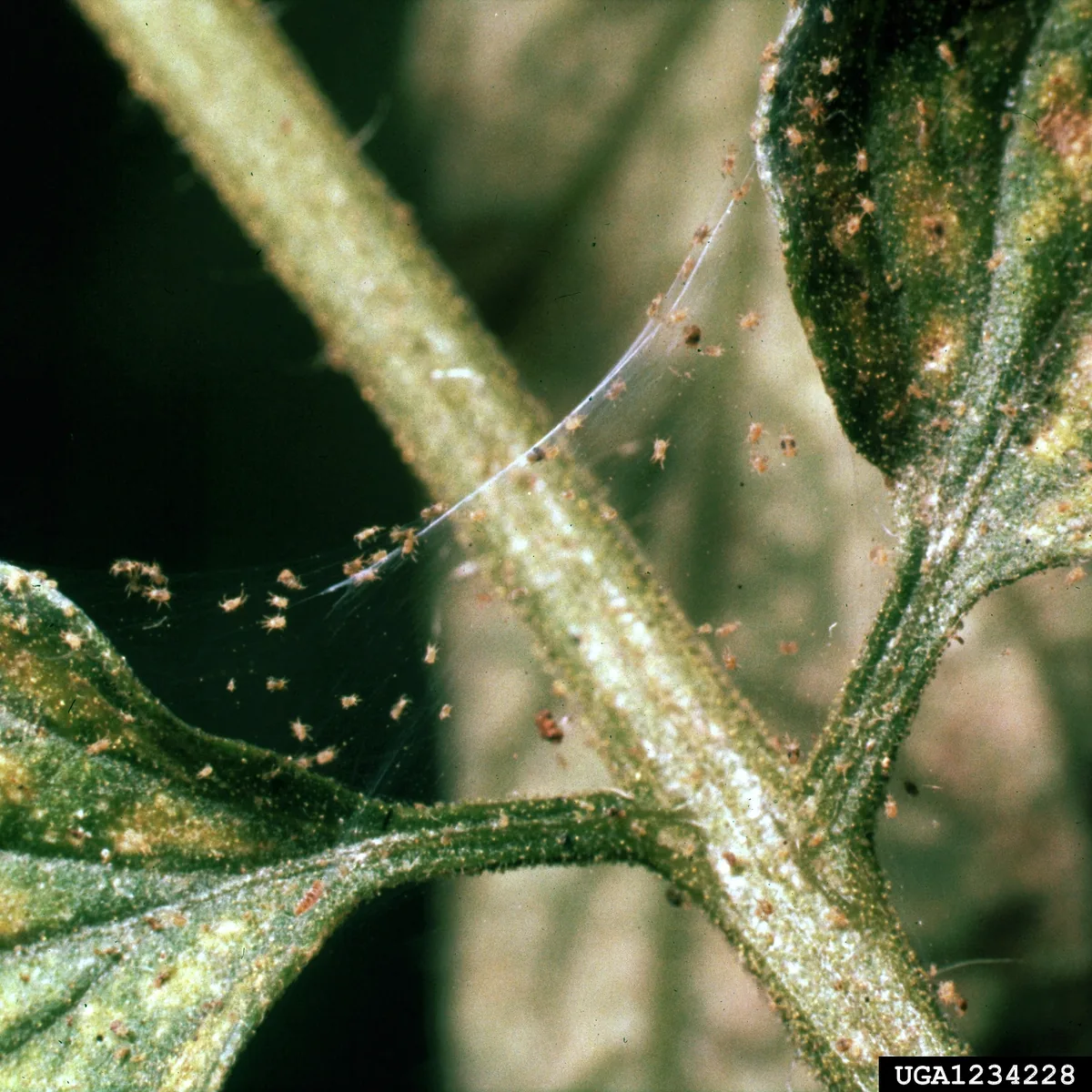
What does spider mite damage look like?
Spider mite damage starts as fine, pale speckling. The University of California Statewide Integrated Pest Management Program (UC IPM) calls it stippling: light dots, sometimes with a bronze cast. Heavily infested leaves can turn yellow and drop, and the University of Minnesota Extension notes that they can look bleached.
The mites themselves are tiny. The Royal Horticultural Society (RHS) says the common species is usually yellowish-green with two dark patches, not red. Turn a leaf over: they live mostly on the undersides.
How do you check for live spider mites?
The white paper test is quick. Iowa State University Extension and Outreach describes it: hold a sheet of white paper under a stem, then shake or tap the stem against the paper.
- Watch the paper. Spider mites show up as tiny specks that move.
- Fold the paper to squish the specks. According to the University of Maryland Extension, this leaves reddish-brown streaks that are easier to see.
- Check the leaf undersides with a 10x hand lens. At that size, UC IPM notes, the mites are easy to see.
Webbing helps too. UC IPM calls it an easy way to tell spider mites from small insects such as aphids and thrips. It also warns that the mites are sometimes gone by the time you notice the damage, so be sure they’re present before you treat.
If the paper stays blank, three photos in Plant Doctor, an AI plant diagnosis app for iPhone, give you the most likely cause and the evidence behind it.
Are the speckles spider mites or something else?
| What you notice | What to check | A useful next step |
|---|---|---|
| Fine pale speckles, and specks that move on white paper | The leaf undersides, with a hand lens. | Live spider mites: move the plant away from others and rinse it today. |
| Dense webbing at leaf joints, with specks crawling on it | How thick the silk is, and whether anything moves on it. | Treat it as spider mites. One loose web with a single larger spider isn’t a mite problem. |
| Silvery streaks with tiny black dots | Slender insects that run or jump on the paper. | Likely thrips. Read the guide to silvery streaks with black specks. |
| Speckles, but nothing moves on the paper | Test again in a few days, and watch the new leaves. | The mites may be gone. UC IPM says plants often recover after mites leave. Hold off on spraying. |
| Even paleness or yellowing, with no speckles, webbing or specks | Light, watering and feeding. | Maryland Extension notes that nutrient yellowing can be mistaken for mite damage. Compare causes of pale leaves without specks or even yellowing. |
Which outdoor plants get spider mites?
Spider mites feed on garden plants too. UC IPM calls them important pests of field-grown roses, and Maryland Extension lists beans, tomatoes, cucumbers, squash and melons among vegetables prone to mite outbreaks.
Outdoors, damage is usually worst in hot, dusty conditions and on plants short of water, according to UC IPM. Spruce spider mites are the exception: Maryland Extension says they’re adapted to cool weather, and heavy damage on evergreens such as dwarf Alberta spruce can look like normal seasonal needle drop.
What should you do first about spider mites?
Isolate the plant, as Minnesota Extension advises, and start with steps that need no product.
- Wash your hands and tools after you handle the plant. Mites can spread on hands, clothing and watering cans, Minnesota Extension warns.
- Rinse the leaf undersides daily while plants are infested, as UC IPM advises. Iowa State suggests a forceful spray of water in the bathtub or shower. For garden plants, Maryland Extension suggests knocking the mites off with a hard spray of plain water from the hose.
- Trim heavily speckled leaves, since Maryland Extension says they won’t recover.
A heavily infested houseplant is usually best discarded, according to Iowa State. Maryland Extension agrees for indoor and outdoor plants: it’s simpler and generally cheaper than treatment.
Which sprays work on spider mites?
If rinsing doesn’t keep up, UC IPM names insecticidal soap or horticultural oil as the selective choices. Check that the label states the product controls mites, as Maryland Extension advises. Indoors, choose one labeled for houseplants. Outdoors, the label must cover that plant and that site. Follow the product label for how often to repeat.
- Test it on a small part of the plant first. UC IPM warns that these products may injure some plants.
- Water the plant before you spray. UC IPM says not to use soaps or oils on water-stressed plants or when temperatures exceed 90°F.
- Cover the leaf undersides. The spray must touch the mites.
Skip general bug sprays. Spider mites frequently become a problem after insecticides are used, often because the sprays kill the mites’ predators, UC IPM explains. Maryland Extension warns this can make an outbreak worse. Read why not dish soap and the checks to make before you use any product.
How do you keep spider mites from coming back?
Spider mites thrive in warm, dry conditions, according to Minnesota Extension, which advises checking plants before you bring them home or indoors for the winter. South Dakota State University Extension points to heated homes in winter, when humidity is usually at its lowest. Water plants enough that they don’t dry out: drought stress makes plants less tolerant of mite feeding, Maryland Extension notes.
Misting helps but isn’t enough. The RHS says spraying plants with water and keeping humidity high reduce the risk “but will not, on its own control this mite.”
Spider mite questions
How is spider mite webbing different from a spider web?
Spider mite webbing is denser, and many mites crawl on it. A spider’s web usually has finer, less dense threads, according to Maryland Extension. Spiders are larger and don’t damage plants.
What houseplants do spider mites like?
Any plant can get them. A Minnesota Extension educator writes that palms, philodendrons and figs tend to see more outbreaks, while succulents and cacti, pothos, snake plant, hoya and ferns tend to see fewer.
The ASPCA lists some plants named on this page, such as pothos and snake plant, as toxic to dogs and cats. These notes are educational, not veterinary advice. If a pet has chewed a plant, call your vet or an animal poison control line. See which plants the ASPCA lists as toxic.
Sources and further reading
Care guidance checked against the sources below. Plant Doctor’s app examples are separate from these references; the institutions do not endorse the app.
- UC Statewide IPM Program — Pest Notes: Spider Mites
- University of Maryland Extension — Mites in home gardens
- Iowa State University Extension and Outreach — How can I determine if my houseplant has spider mites?
- Iowa State University Extension and Outreach — How do I control spider mites on houseplants?
- University of Minnesota Extension — Managing insects on indoor plants
- University of Minnesota Extension — Houseplant pests
- Royal Horticultural Society — Glasshouse red spider mite
- South Dakota State University Extension — Watch out for houseplant pests
- US Environmental Protection Agency — Introduction to pesticide labels
- ASPCA Animal Poison Control — Toxic and non-toxic plants list
This guide offers general plant-care information. A photo cannot confirm every cause; a local nursery or extension service can help with severe or unclear cases.