
How do you get rid of aphids on indoor plants?
Rinse them off. Aphids cluster on soft new growth and buds, and a strong spray of plain water in the sink or shower knocks most of them off. Check again at least twice a week, because aphids multiply quickly. If they keep coming back, use an insecticidal soap labeled for houseplants rather than a homemade dish soap mix.
Updated
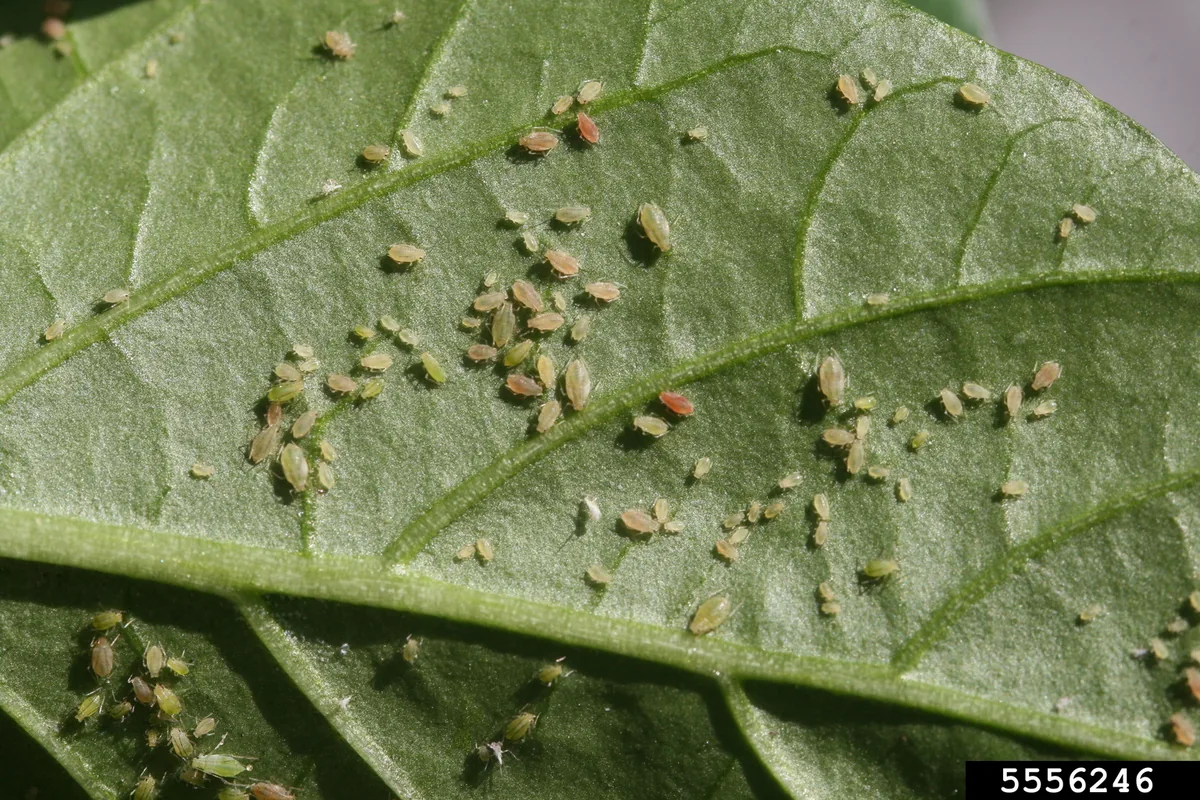
How do you know they’re aphids?
Aphids are soft, pear-shaped insects packed onto shoot tips and buds. The University of California Statewide Integrated Pest Management Program (UC IPM) says they can be green, yellow, brown, red or black, and most don’t move fast when disturbed. Check flower buds and the undersides of young leaves too, where the Royal Horticultural Society (RHS) notes many species colonize.
Look at the rear end with a hand lens. The University of Maryland Extension describes two cornicles that look like a pair of tailpipes, and according to UC IPM, cornicles set aphids apart from all other insects.
| What you notice | What to check | A useful next step |
|---|---|---|
| Clusters of soft insects on shoot tips and buds | Two tailpipes at the rear, seen with a hand lens. | Aphids. Rinse the plant today. |
| White flecks on the leaves below a cluster | Shed aphid skins. The RHS says white cast skins collect on the upper surface of leaves. | Not a disease. Look higher up for the colony. |
| Sticky, shiny leaves or a black coating | Honeydew from the aphids, and sooty mold growing on it. | Wipe it with a damp cloth, as the RHS suggests. Read about sticky leaves and sooty mold. |
| New leaves curled or crinkled | Aphids tucked inside the curl. | Trim curled leaves with aphids inside. Compare other causes of curled leaves. |
| White cottony insects in leaf joints that barely move | Wax over the body. | Probably mealybugs. Read about white cottony insects. |
How do you rinse aphids off a plant?
A strong spray of plain water is the first step. Most dislodged aphids won’t be able to return to the plant, UC IPM explains, and the spray washes off their honeydew too.
- Move the plant away from the others first, as the University of Minnesota Extension advises.
- Spray small plants in a sink and large ones in a shower, another Minnesota Extension tip. Cover both sides of the leaves.
- Rub off or squash the rest with your fingers, as Maryland Extension and the RHS suggest.
- Trim curled leaves with aphids still inside. UC IPM notes that contact sprays won’t reach them.
- Check again at least twice a week while the plant is growing fast, UC IPM advises.
Distorted new growth with no insects in sight has other causes. Plant Doctor, an AI plant diagnosis app for iPhone, suggests the most likely one from three photos and sets out a step-by-step care plan.
What about aphids on roses, milkweed and other garden plants?
Most established garden plants can live with aphids. UC IPM says aphids often build up on roses, crape myrtles, flowering plums and many vegetables, but most established plants tolerate the feeding and outgrow the damage. To clear them, Maryland Extension suggests a blast of plain water from a garden hose.
Garden plants also have help. UC IPM names lady beetles, lacewings, syrphid fly larvae and tiny parasitic wasps as natural enemies of aphids. In spring, if you wait a while, the RHS says they’ll often give control. On milkweed, Maryland Extension describes the oleander aphid as bright orange-yellow, feeding mainly on milkweeds, oleander and hoya.
When should you use insecticidal soap on aphids?
Only when rinsing isn’t keeping up. Aphid feeding rarely requires pesticides, even low-risk ones like insecticidal soap, according to Maryland Extension.
- Indoors, choose an insecticidal soap labeled for houseplants that lists your plant, as Minnesota Extension advises. Outdoors, the label must cover that plant and that site. Follow the product label.
- Test a small area first. Clemson Cooperative Extension says some plants are sensitive to soap sprays and names maidenhair fern, crown of thorns and gardenias among them.
- Water the plant a day or two before, since Minnesota Extension warns against spraying a plant that’s short of water.
- Wet the colonies and leaf undersides, and repeat as the label directs. Soaps kill only the aphids present on the day you spray, UC IPM notes.
Read the checks to make before you use any product.
Why not use dish soap?
Dish soap is not a labeled pesticide, and extension services advise against homemade soap sprays. Colorado State University Extension says household soaps should not be used as pesticides, for three reasons. Dish soaps contain powerful detergents that can injure plants, damage soil and contaminate waterways. Homemade pesticides are not consistently made or tested, so there’s no evidence they control pests. And household soaps used as pesticides are of questionable legality.
A homemade mixture can injure plants: Clemson warns of a substantially increased risk compared with commercial insecticidal soap. Maryland Extension’s advice is plain: no home remedies like household soap or detergent.
A labeled insecticidal soap is different. Colorado State says commercial products are selected to minimize plant injury and must meet legal label requirements.
Why do aphids keep coming back?
A few survivors are enough. UC IPM says adult females can give birth to live young, often as many as 12 per day, without mating.
- Hidden aphids. Colorado State notes that aphids within curled leaves can’t be fully wetted, so they survive.
- Winged aphids. Winged forms develop when colonies get crowded, and they move to other plants, according to the RHS.
- Plants coming in for winter. A Minnesota Extension educator writes that pests hitch a ride when collections come indoors.
- Soft growth. Aphids feed on soft, new growth, so UC IPM advises not to overfertilize.
Aphid questions
Why are there aphids on my indoor plants?
Usually they came in on a plant. Maryland Extension’s list of indoor hosts includes orchids, gardenias, citrus, succulents and patio tropicals like hibiscus brought in for winter. Once inside, the RHS says aphids stay active all year.
Can aphids live in the soil?
A few kinds can. Most aphids feed on leaves, stems and flowers, but some feed on roots, according to the RHS. Maryland Extension notes that root-feeding aphids and root mealybugs can be hard to tell apart.
Can you make insecticidal soap at home?
Extension services advise against it. Minnesota Extension warns that homemade soap products can burn plants, and Colorado State says there’s no evidence they control pests.
The ASPCA lists some plants named on this page, such as oleander and milkweed, as toxic to dogs and cats. These notes are educational, not veterinary advice. If a pet has chewed a plant, call your vet or an animal poison control line. See which plants the ASPCA lists as toxic.
Sources and further reading
Care guidance checked against the sources below. Plant Doctor’s app examples are separate from these references; the institutions do not endorse the app.
- UC Statewide IPM Program — Pest Notes: Aphids
- University of Maryland Extension — Aphids in home gardens
- Royal Horticultural Society — Aphids
- University of Minnesota Extension — Managing insects on indoor plants
- University of Minnesota Extension — Houseplant pests
- Colorado State University Extension — Insect control: insecticidal soap
- Clemson Cooperative Extension — Insecticidal soaps for garden pest control
- US Environmental Protection Agency — Introduction to pesticide labels
- ASPCA Animal Poison Control — Toxic and non-toxic plants list
This guide offers general plant-care information. A photo cannot confirm every cause; a local nursery or extension service can help with severe or unclear cases.