
What are the orange spots on your plant’s leaves?
Orange, yellow or rusty-brown spots with powdery bumps under the leaf are most often rust, a fungus. Rub a spot gently with a white tissue: rust leaves colored powder. Each rust infects only a limited group of plants, so it usually stays off unrelated ones. A little spotting rarely harms a plant. Pick off a few affected leaves and keep the foliage dry.
Updated
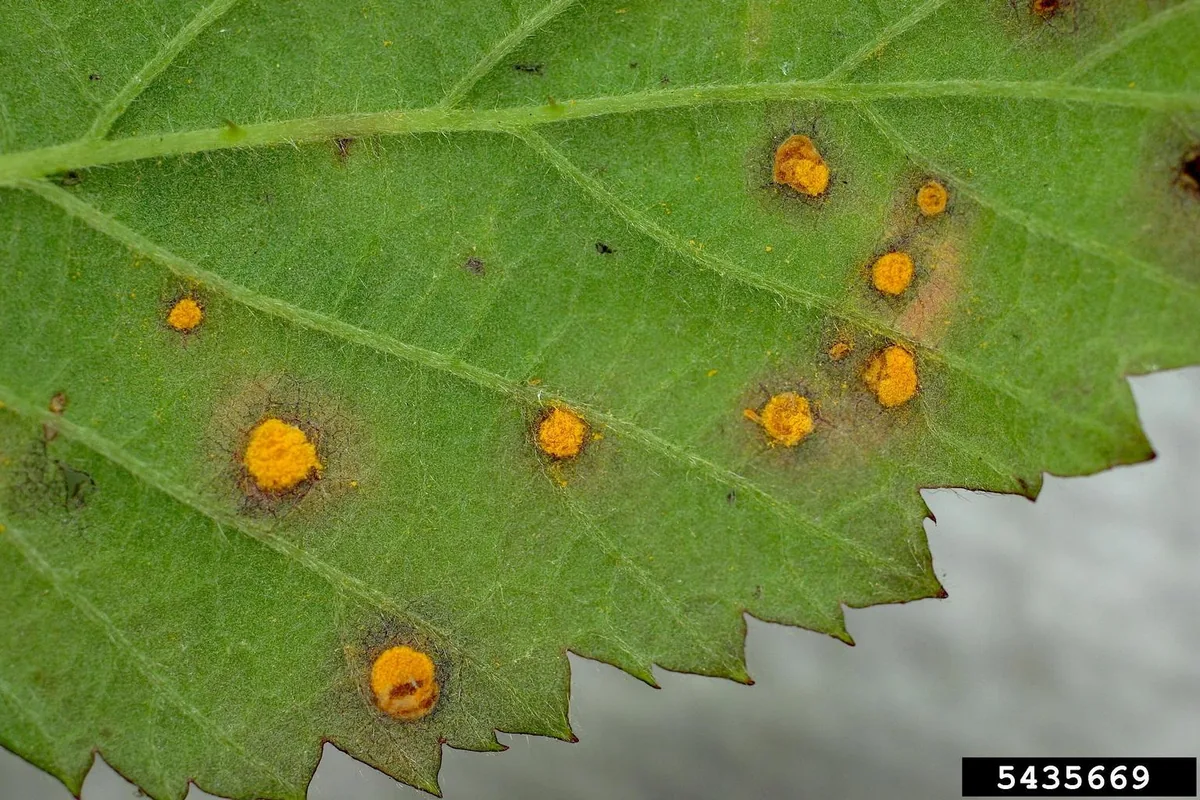
What does rust look like on leaves?
Rust usually shows as pale or yellow spots on the top of a leaf, with powdery bumps called pustules underneath. The Royal Horticultural Society (RHS) says the pustules are found most often on the lower leaf surface and can be orange, yellow, brown, black or white. The University of Minnesota Extension says the pustules form on the lower surface just below the spots.
The color can change with the season. On roses, the RHS says orange pustules turn black in late summer. Badly infected leaves may turn yellow or brown or fall off, Minnesota Extension notes. For a photo, a close shot of the leaf underside shows the most. The guide to photographing a sick plant covers the rest.
How can you tell it’s rust?
Rub and flip. Minnesota Extension says rust spores can easily be seen as a colorful powder on your hands or on a white tissue gently rubbed on the leaf. Washington State University (WSU) Extension says rust is usually easy to spot. Naming the exact rust can take a microscope.
| What you notice | What to check | A useful next step |
|---|---|---|
| Orange or yellow powdery bumps under the leaf, pale spots on top | A gentle rub with a white tissue leaves colored powder. | Likely rust. Pick off a few leaves and keep the foliage dry. |
| Black spots with feathery edges on a rose, nothing underneath | The underside is clean. The University of California Statewide Integrated Pest Management Program says black spot grows no fungus there. | Likely black spot. See black spot on roses. |
| Bright orange-red spots on apple or crabapple leaves, with tiny tubes underneath | A juniper or red cedar nearby with galls that grow orange, gummy horns in wet spring weather. | Likely cedar-apple rust. Minnesota Extension says it rarely causes serious damage. Choose a resistant variety next time. |
| White powder, not orange, on both sides of the leaf | Whether the powder covers the surface rather than sitting in bumps. | See white powder on leaves. |
| Orange or brown spots that leave the tissue clean | No powder and no bumps under the leaf. | Rust is less likely. Try the brown spots guide, and ask a nursery if it spreads. |
Plant Doctor, an AI plant diagnosis app for iPhone, offers another check when the tissue test is unclear. Send three photos for the most likely cause, the evidence behind it and a step-by-step care plan.
Will rust spread to your other plants?
Usually not to unrelated plants. The RHS says rust fungi have “very limited host ranges,” and gives an example: the rust on snapdragons is a different species from the one on hollyhocks. Minnesota Extension says hollyhock rust infects only hollyhocks and weeds in the hollyhock family.
Rust does spread on the same kind of plant. Minnesota Extension says the spores travel easily on the wind and sometimes in splashing water. They need wet leaves to start a new infection. Weeds in the same family can carry it too.
Some rusts need two unrelated plants. Cedar-apple rust spends half its life on junipers and half on apples or crabapples. Its spores, Minnesota Extension says, “can infect trees over a mile away,” so cleaning up under your own tree won’t stop next year’s spots.
What should you do about rust?
Start small. Minnesota Extension says a little spotting won’t significantly affect a plant’s health and growth, and suggests tolerating low levels of rust. Non-chemical steps come first in WSU’s advice too. These steps are Minnesota’s unless another source is named:
- Pinch off infected leaves and take them out of the garden, but remove no more than a third of the leaves at once. The RHS warns that stripping many leaves is likely to do more harm than good.
- Water the soil, not the leaves. If a sprinkler is your only option, water early on a sunny day so leaves dry fast.
- Space plants for air movement, and thin or divide crowded perennials.
- Go easy on nitrogen. The RHS says too much makes soft, lush growth that rust colonizes easily.
- At the end of the season, remove infected plant debris from the garden. Missouri Botanical Garden gives the same advice.
- Check new plants before you buy. Look at the inner and lower leaves and pass on any plant with yellow, orange or red spots.
If a plant is badly hit every year, Minnesota suggests replacing it with a resistant variety or a plant from a different family. Resistance can wear off, it adds, as the rust population changes.
Do you need a fungicide for rust?
Rarely. Minnesota Extension says fungicides are rarely necessary in a home garden. It keeps them for high-value plants with a history of severe rust. The RHS recommends that you don’t use fungicides.
A fungicide protects healthy leaves; it doesn’t fix spotted ones. Minnesota Extension says fungicides “will not cure or remove existing rust infections.” If you use one, choose a product labeled for that plant and for outdoor use, and follow the product label. The US EPA’s pesticide label guide says it plainly: “the label is the law.” The checks to make before you spray are worth reading first.
Rust questions
Will rust fungus kill plants?
Seldom. Minnesota Extension says rust rarely does significant damage to a plant’s health. The RHS says heavy infection often reduces vigor, and in extreme cases, such as snapdragon rust, the plant can be killed. Replace a plant that is badly hit every year.
Why does my apple tree have orange spots?
Cedar-apple rust is a likely cause if junipers or red cedars grow in your area. Minnesota Extension describes leaf spots that start yellow and turn bright orange-red, and says the disease is only a minor problem on resistant trees. Missouri Botanical Garden notes that resistant apple and crabapple varieties are available.
Can I compost leaves with rust?
It depends on the season. The RHS says spring and early summer spores are generally short-lived and should be killed by home composting, but some rusts make tougher overwintering spores in late summer and fall, so dispose of those leaves another way. Minnesota Extension advises a pile that heats up well or a municipal compost facility.
The ASPCA lists apple, including crabapples, as toxic to dogs and cats, with difficulty breathing, dilated pupils and shock among the signs. It lists hollyhock and rose as non-toxic. See which plants the ASPCA lists as toxic. These notes are educational, not veterinary advice. If a pet has chewed the plant, call your vet or an animal poison control line.
Sources and further reading
Care guidance checked against the sources below. Plant Doctor’s app examples are separate from these references; the institutions do not endorse the app.
- University of Minnesota Extension — Rust in the flower garden
- University of Minnesota Extension — Cedar-apple rust and related rust diseases
- Royal Horticultural Society — Rust diseases
- Royal Horticultural Society — Rose rust
- Washington State University Hortsense — Common diseases: rusts
- Missouri Botanical Garden — Rusts
- UMass Extension — Rust diseases of ornamental crops
- UC Statewide IPM Program — Roses: diseases and abiotic disorders
- US Environmental Protection Agency — Introduction to pesticide labels
- ASPCA Animal Poison Control — Apple
- ASPCA Animal Poison Control — Hollyhock
- ASPCA Animal Poison Control — Rose
This guide offers general plant-care information. A photo cannot confirm every cause; a local nursery or extension service can help with severe or unclear cases.