
Why does your rose have black spots on its leaves?
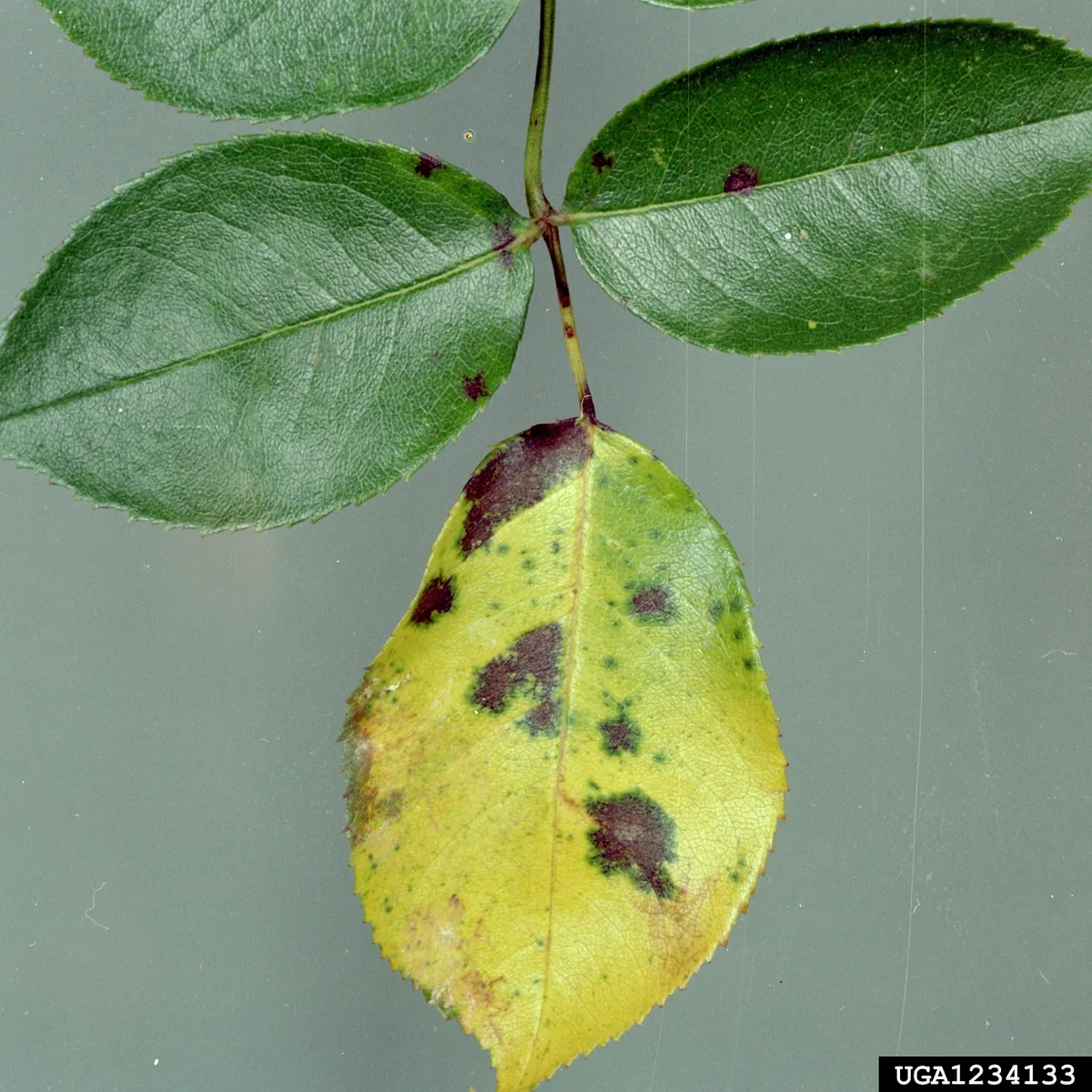
If a rose has round black spots with feathery edges and the leaves then yellow and drop, it most likely has black spot, a fungus that spreads in water on wet leaves. Turn a leaf over: black spot leaves the underside clean. Spotted leaves won’t recover, so protect new ones. Clear fallen leaves, water at the base in the morning, and give the bush sun and air.
Updated
What does black spot on roses look like?
Black spot shows as round black or purplish spots on the top of rose leaves, often with fringed, feathery edges. Clemson Cooperative Extension says the spots grow to about half an inch across and become surrounded by yellow. The Royal Horticultural Society (RHS) adds that the leaf often drops, even while the rest of the plant looks fine.
Nebraska Extension (University of Nebraska-Lincoln) says lower leaves are usually infected first. Young canes can show raised purple-red blotches, according to Clemson.
Is it black spot or something else?
Flip the leaf. The University of California Statewide Integrated Pest Management Program (UC IPM) describes black spot as black spots with feathery margins on the upper surface, and says, “No fungal growth occurs on the undersides.”
| What you notice | What to check | A useful next step |
|---|---|---|
| Black spots with feathery edges on top, and the leaf yellowing | The underside is clean, with no powder or felt. | Most likely black spot. Start the dry-leaves routine below. |
| Discolored spots on top and small orange bumps underneath | Small orange pustules on the underside of the leaf. | Likely rust. See orange spots on leaves. |
| Angular purple, red or brown spots between the veins, and leaves that yellow and drop | Pale, felty patches under the leaf, sometimes present. | Possibly downy mildew. UC IPM advises pruning for air flow and avoiding frequent overhead watering. |
| Red or purple spots that turn gray or white in the middle | Whether some centers have fallen out, leaving small holes. | Possibly anthracnose. UC IPM suggests soaker hoses or drip, spacing and cleanup. |
| White to gray powder on both sides of leaves and on buds | Powder on both surfaces, not spots. | Likely powdery mildew. See white powder on leaves. |
If no row fits, the brown spots guide covers other causes. Plant Doctor, an AI plant diagnosis app for iPhone, can help sort out rose spots: from three photos, it gives the most likely cause, the evidence behind it and a step-by-step care plan.
Will the spotted leaves recover?
No. The RHS says the leaf markings “persist as long as the leaves remain on the plant.” Treatment protects new growth: Nebraska Extension describes fungicide applications as protecting “newly emerging foliage.” The University of Maine Cooperative Extension says that, left alone, the disease progressively weakens a rose so fewer and fewer blooms form. Nebraska adds that branches are rarely killed by the cane lesions.
What should you do first?
Start with the steps that keep leaves dry and remove the fungus. Washington State University (WSU) Extension tells gardeners to choose non-chemical options first. Black spot needs water on the leaf. UC IPM says it grows when leaves stay wet for more than seven hours, and Maine Extension and Nebraska give the same figure.
- Pick off spotted leaves as they appear, in dry weather, as Maine Extension and Clemson advise. If most leaves are spotted, don’t strip the bush; focus on cleanup and protecting new growth.
- Rake up fallen leaves. WSU says not to compost diseased material.
- Water the soil, not the leaves. Clemson advises against overhead watering, especially in the late afternoon or evening. If you must wet the leaves, WSU says to do it in the morning so they dry quickly.
- Give the rose full sun and space. Clemson and Maine Extension both say sun and air speed drying.
- Prune out cane lesions. The RHS says to prune out all stem lesions in spring before leaves appear.
The RHS says cleanup delays the disease but is of limited value, because spores blow in on rain from elsewhere.
Do you need a fungicide?
Often not. UC IPM says many gardeners can grow roses with little to no use of fungicides, especially in dry climates, and the RHS recommends that you don’t use them. Several US extension services treat fungicides as an option for susceptible roses in wet seasons. UC IPM says potassium bicarbonate, sulfur and oils, including neem oil, have been shown to reduce black spot. It warns not to apply oils to water-stressed plants or within two weeks of a sulfur spray.
If you decide to spray, choose a fungicide labeled for roses and for outdoor use. Follow the product label for how and how often, including any warnings on heat, and don’t mix products. “The label is the law,” as the US EPA says. Nebraska notes that repeat applications at the intervals on the label may be needed to protect new leaves. Before you buy anything, read the checks to make before you spray.
Why does black spot come back every year?
The fungus waits on the plant and the ground. The RHS says it spends the winter on fallen leaves and in dormant infections on young stems and buds, then infects young leaves in spring.
A resistant rose helps, but expect some spots. Nebraska says hybrid teas, grandifloras and miniature roses are more susceptible, while floribundas, shrub roses and climbers are more resistant or tolerant. The RHS warns that bred-in resistance usually fails to last, because new strains of the fungus arise to overcome it.
Black spot questions
Does baking soda work for black spot?
The evidence is weak. The University of Washington’s Miller Library reports that WSU’s Linda Chalker-Scott says baking soda sprays may have only limited efficacy, and that she calls milk and compost tea sprays ineffective. Brooklyn Botanic Garden, which the library quotes, warns that bicarbonate sprayed again and again can build up in the soil and slow growth. The RHS says homemade products are not recommended because they are unregulated and usually untested. None of the sources listed here mentions cinnamon. Clearing leaves and keeping them dry has far more support.
Are the black spots on my rose stems the same disease?
Often, yes. Clemson and Nebraska describe raised purple or purple-red blotches on young canes, and WSU mentions small reddish-purple to black spots. The RHS says to prune these lesions out in spring before the leaves appear.
The ASPCA lists roses as non-toxic to dogs and cats. A treated plant is a separate question: follow the product label on keeping pets away. See which plants the ASPCA lists as toxic. These notes are educational, not veterinary advice. If a pet has chewed a sprayed plant, call your vet or an animal poison control line.
Sources and further reading
Care guidance checked against the sources below. Plant Doctor’s app examples are separate from these references; the institutions do not endorse the app.
- UC Statewide IPM Program — Roses: diseases and abiotic disorders
- Royal Horticultural Society — Rose black spot
- Clemson Cooperative Extension — Rose diseases
- University of Maine Cooperative Extension — Black spot of rose
- Nebraska Extension — Black spot of rose (NebGuide G1060)
- Washington State University Hortsense — Rose: black spot
- University of Washington Botanic Gardens, Miller Library — Managing black spots on roses
- US Environmental Protection Agency — Introduction to pesticide labels
- ASPCA Animal Poison Control — Rose
This guide offers general plant-care information. A photo cannot confirm every cause; a local nursery or extension service can help with severe or unclear cases.