
How much light does a houseplant actually need?
Most houseplants grow best in bright, indirect light, and indoor light is usually dimmer than it looks. Florida and Maryland extension guides put low light at about 25 to 100 foot-candles, medium at 100 to 500, and high at 500 to 1,000. Your eyes adjust too well to judge this, so measure the spot, then watch how the plant grows.
Updated
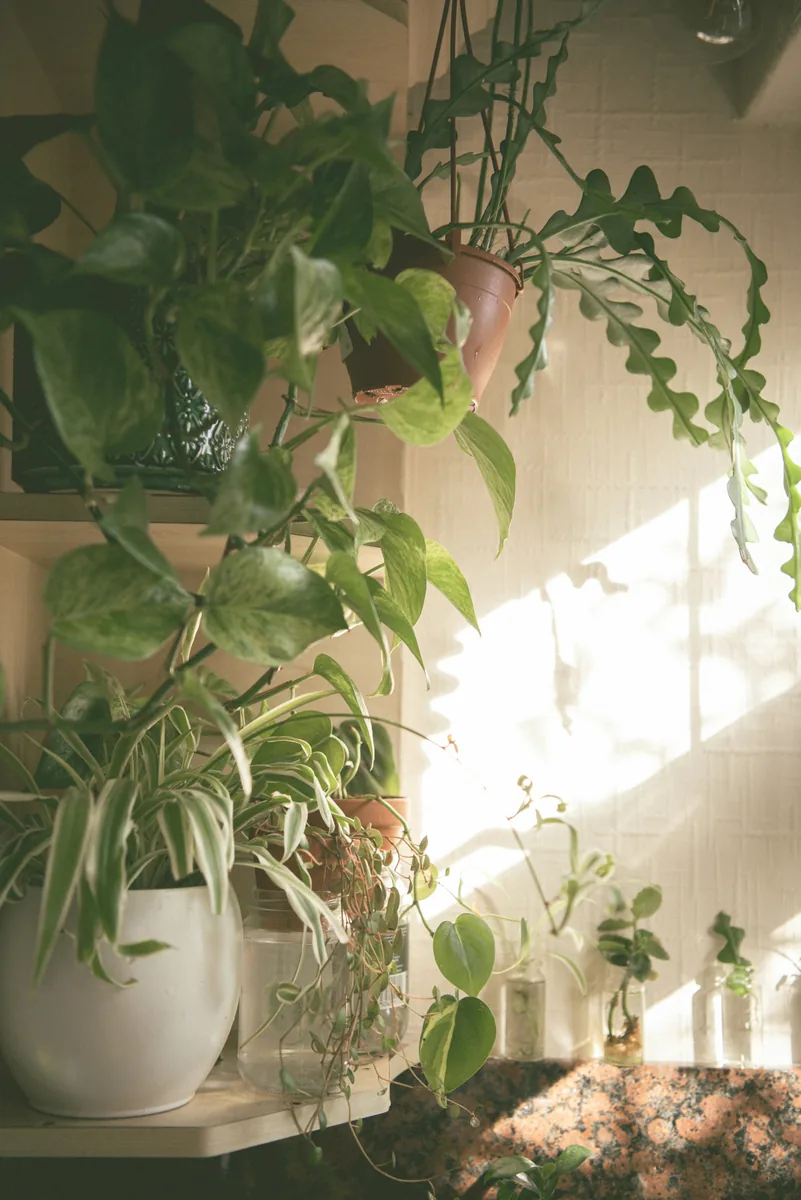
What do low, medium and bright light mean in numbers?
The labels on a plant tag stand for rough bands of brightness. The University of Florida IFAS Extension (UF/IFAS) calls terms such as “low,” “medium” and “bright, indirect light” generalizations, not scientific terms. It also explains why you can’t judge them by eye: “Human eyes are very adaptable. This makes us poor judges of light intensity.” A desk by the window may be ten times brighter than a spot across the hall and look much the same.
| Light level | Foot-candles | Approx. lux | Where you often find it |
|---|---|---|---|
| Low | 25–100 | 270–1,100 | Far from windows, in rooms lit mostly by ceiling lights (UF/IFAS); north windows (Maryland) |
| Medium | 100–500 | 1,100–5,400 | Near windows with no direct sun: unshaded north or shaded east and west windows (UF/IFAS); east or west windows (Maryland) |
| High | 500–1,000 | 5,400–10,800 | Near unshaded east or west windows or shaded south windows, with any direct sun softened (UF/IFAS); south or some west windows (Maryland) |
| Direct sun | Over 1,000 | Over 10,800 | Right in front of unshaded south or southwest windows, four or more hours of sun (UF/IFAS); Maryland says 4 to 6 hours |
Other extension services draw the lines elsewhere. University of Georgia Extension calls 25 to 75 foot-candles low and 75 to 200 medium. Clemson Cooperative Extension puts low light at about 100 foot-candles and notes that a well-lit home is often under 100 inside. Treat any scale as a guide, not a rule.
How much light does each window give?
Window direction gives a first guess, and distance from the glass matters as much. Georgia Extension says east windows can read 5,000 to 8,000 foot-candles in direct morning sun, and that south and west exposures are interchangeable for most plants. North gives the least. Georgia says a north windowsill can measure as low as 200 foot-candles on a clear winter day, and UF/IFAS says a north window may never reach 400 in winter.
Iowa State University Extension and Outreach says curtains, roof overhangs, trees, nearby buildings and window size all change what comes in. Light also falls off fast as you move back. The University of Maryland Extension says intensity “decreases rapidly with increasing distance,” and Iowa State notes that spots more than a few feet from even bright windows are often too dim to grow houseplants well. Spots just to the side of a window are darker than they look. For window light, Iowa State says it is usually more effective to raise intensity, with a better window or a spot closer to it, than to give the same light for longer.
Can you measure light with your phone?
Yes, roughly. UF/IFAS says the accuracy of phone light apps varies with the device and how it calculates. They are “usually accurate enough to determine a change in light levels but should only be used for approximations.” Iowa State calls such apps adequate for the typical home gardener. A handheld meter that reads foot-candles or lux to one foot-candle is enough, UF/IFAS says.
- Measure at leaf height, and set the app or meter for the light source, such as daylight, LED or fluorescent, as Iowa State advises.
- Take readings around midday, compare spots, and check again in winter.
Know what the number means. Iowa State explains that lux and foot-candles measure light as the human eye sees it, not the wavelengths plants use, so a reading is a comparison tool. Without a meter, use the shadow check in the questions below.
Is your plant getting the right amount of light?
The plant’s new growth tells you. Georgia Extension lists the low-light signs: longer gaps between leaves on new growth, smaller new leaves, and new leaves a lighter green than the old ones.
| What you notice | What to check | A useful next step |
|---|---|---|
| Stretched new growth with longer gaps between leaves, or a lean toward the window | Distance from the window and a reading at leaf height. | Move it closer to a brighter window, or add a grow light. The leggy growth guide covers the stems already stretched. |
| Variegated leaves turning plain green | Whether it sits in low light. Georgia notes that variegation tends to fade in low light. | Move it to brighter, indirect light. |
| Pale, bleached or brown patches on the side facing the glass | Hours of direct sun through the window, especially in summer. | Move it back or add a sheer curtain, and make the change gradually. See pale or bleached leaves. |
| Little or no growth in winter, with leaves otherwise healthy | The season and day length. | Expect slower growth; the plant may be resting rather than dead. A brighter window or a grow light can help. |
| A reading under about 100 foot-candles where you want a plant | What the plant’s tag says. | Choose a plant suited to low light, or add a grow light. |
Too much sun does harm too. Maryland Extension says leaves that get too much direct light become pale, turn brown and die, and suggests moving plants back from the window or using a sheer curtain in summer. Clemson advises making any change in light gradual.
Plant Doctor, an AI plant diagnosis app for iPhone, can look at stretched, pale or scorched growth for you. From three photos, it gives the most likely cause and a step-by-step care plan.
When does a grow light make sense?
A grow light makes sense when no window gives enough light for the plants you want. Iowa State says supplemental light will be needed in that case. UF/IFAS says plants can be grown entirely under artificial light and that, with an appropriate source, many can’t tell the difference. It names fluorescent and LED lights as the best options.
Iowa State suggests 12 to 14 hours of light a day, and no fewer than 10 or more than 16. Maryland Extension also says no more than 16 hours in total, because most plants need a dark period. Moving a fixture closer raises intensity, but Iowa State warns that a fixture that gives off a lot of heat can then damage the plants.
Houseplant light questions
What does bright indirect light look like?
Iowa State describes it as light bright enough to cast a distinct shadow, with no sun rays hitting the leaves. UF/IFAS calls the label a general term, so measure the spot if you can.
Is a north-facing window good for plants?
A north window gives the least light. It can suit low-light plants placed close to the glass, but Georgia Extension says a north windowsill can measure as low as 200 foot-candles on a clear winter day.
Are light meter apps accurate for plants?
They are good enough to compare spots and notice changes. UF/IFAS says to use the numbers only as approximations. Measure at leaf height and set the app for the light source.
Do grow lights work for houseplants?
Yes, if the light is suitable. UF/IFAS names fluorescent and LED lights as the best options, and Iowa State suggests 12 to 14 hours a day.
Sources and further reading
Care guidance checked against the sources below. Plant Doctor’s app examples are separate from these references; the institutions do not endorse the app.
- UF/IFAS Extension — Light for houseplants
- University of Maryland Extension — Lighting for indoor plants
- Iowa State University Extension and Outreach — How to care for houseplants
- Iowa State University Extension and Outreach — Important considerations for providing supplemental light to indoor plants
- University of Georgia Extension — Growing indoor plants with success
- Clemson Cooperative Extension — Indoor plants: cleaning, fertilizing, containers and light requirements
This guide offers general plant-care information. A photo cannot confirm every cause; a local nursery or extension service can help with severe or unclear cases.